

Motorsport · Rally Report
Rally of Himalayas 2026: Rajiv Yadav and Daksh Gill Headline a Grueling Finish in Zanskar
Fifty cars and eighty riders left Manali on 26 September chasing one of Indian motorsport’s hardest routes. Four days and a reversed 72-km special stage later, it was Rajiv Yadav lifting the Xtreme crown in Padum, with Daksh Gill’s late surge through Shinku La and the Zanskar Valley the story of the back half.
50 cars, 80 riders, one of India’s toughest rally raids.
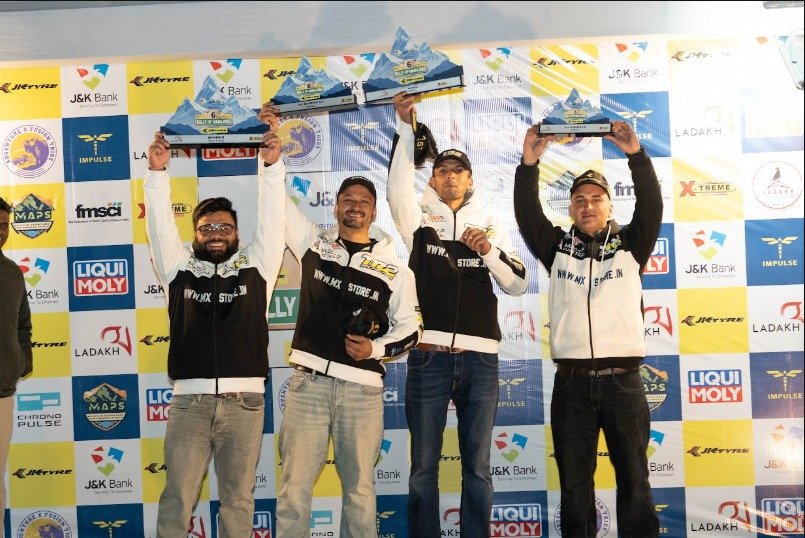
The JK Tyre Rally of Himalayas 2026, presented by J&K Bank, concluded on 30 September in Padum after more than four days of competition across the high-altitude terrain of Lahaul-Spiti and Zanskar. Rajiv Yadav, paired with Rohit Gowda, took the Xtreme (4-wheel) title after setting the pace from day one, while Dhritimaan Singh topped the Moto field and Soham Hazra and Nirav Mehta won the Adventure category. The more interesting story, though, belonged to Daksh Gill, who was nowhere near the lead after the opening stages and spent the second half of the rally clawing his way up the standings through some of the route’s most punishing terrain.
Rally raids are not won on a single flying stage, and this year’s edition made that point early. The route out of Manali ran through Lahaul and Spiti and over Kunzum La, a pass whose reputation for extreme conditions and difficult driving lines made it an early filter — competitors had to balance outright pace against the risk of a mechanical problem ending their rally outright. That risk was not hypothetical: Lakhpa Tsering, the 2015 Raid de Himalaya winner, was forced to retire his Toyota Hilux to a technical issue partway through, a reminder that in terrain like this, reliability is as much a competitive skill as driving.
How the rally turned
The number that frames it
A route climbing past 16,500 feet at Shinku La, where traction and throttle control matter more than horsepower.
Category winners
Rally of Himalayas 2026 · final standings by category
Source: official results, JK Tyre Motorsport / Concept PR
Moto (2-wheel)
Xtreme (4-wheel)
Adventure (4-wheel)
Worth noting from that table: Daksh Gill’s stage-winning run through Shinku La and Zanskar was strong enough to carry him onto the Xtreme podium in third, even after losing time in the earlier going — the clearest sign of how much those two closing stages reshuffled the field.


A finish line in Zanskar, not just Manali
The closing ceremony in Padum leaned into the fact that this rally doesn’t just pass through the Himalayas, it ends inside one of its more remote valleys. The prize distribution was paired with a cultural evening, and the dignitaries in attendance reflected that the event is as much a Ladakh and Zanskar occasion as a motorsport one — among them Arava Gopi Krishna, IAS, Administrative Secretary for Transport and Housing and Urban Development; Moses Kunzang, Staff Officer to the Chief Secretary; Tsewang Dorjai of J&K Bank; Rigzin Sangdup, SP Zanskar; Gulam Mohammed of the Tourism Development Authority; and Sarwar Shehzad, SDM Zanskar.
What it means for the season
For JK Tyre Motorsport, the Rally of Himalayas has long functioned as a proving ground rather than just a trophy event — the brand’s three-decade motorsport programme has fed talent through to national and international racing before, and a rally this physically demanding tends to surface names worth tracking. Daksh Gill’s second half here is the one to watch; a driver who loses time early and still forces his way onto the Xtreme podium through the hardest sections of the route has shown something a results sheet alone won’t fully capture.
For Rajiv Yadav and Rohit Gowda, the win is the more straightforward story: lead from day one, manage the technical middle stages, don’t let the terrain or the reversed special stage catch you out. Both versions of a rally raid happened here in the same four days, and that’s generally the point of an event built around a route this unforgiving.