Editor's desk
Why Indian Football Winning Is BAD News for Some People!
PurePlay Perspective
WHY Indian Football Team Winning Is BAD News for Some People!
India U20 have ended a 20-year wait for the AFC U20 Asian Cup. Instead of uniting Indian football, the historic qualification has exposed a toxic strain of fandom that seems louder when India loses than when India wins.
India’s first AFC U20 Asian Cup appearance since 2006 — sealed with a 3–0 win over Bangladesh in Tashkent.

India U20 have qualified for the AFC U20 Asian Cup after a 20-year wait — and that should be celebrated by every Indian football fan. They did it by beating Bangladesh 3–0 in Tashkent, with goals from Danny Meitei Laishram, Vishal Yadav and Md Arbash, before Uzbekistan’s win over Syria confirmed India as one of the best runners-up.
India are going to the AFC U20 Asian Cup. After 20 years. This is a moment to celebrate the boys wearing the Indian jersey — not a moment to bury their achievement beneath another argument about AIFF, Kalyan Chaubey or who deserves the credit.
And yet, watching the Indian football discourse on social media, you could almost believe that winning itself has become inconvenient for some people.
Let us be clear: Indian football has serious problems
Before anyone misunderstands this editorial, let us establish one thing: Indian football has plenty to fix. AIFF, administration, government policy, the commercial structure, the ISL, the development pathway and the senior national team’s results all deserve scrutiny. Supporters have every right to be angry when India underperforms.
But criticism is not the same as celebrating failure because it strengthens a personal narrative. That is where Indian football needs an uncomfortable conversation.
India’s youth national teams: the real scoreboard
Every major men’s youth qualification campaign, 2023–2026
Source: AIFF, AFC and match reports. India’s U23 side finished second in their group with six points but ranked fifth among all group runners-up — only the top four advanced.
That is not a team in permanent decline, and it is not a team that has “arrived” either. It is a team that keeps knocking on the door — sometimes getting in, sometimes falling just short on margins as thin as a single ranking place. That is precisely the kind of story that deserves consistent attention, not attention that switches on only for the misses.
This is what toxic fandom actually looks like
Let’s name it properly, because “criticism” and “toxicity” are not the same thing, and Indian football’s discourse keeps blurring the two.
Toxic fandom is not disagreeing about tactics. Toxic fandom is not demanding better administration. Toxic fandom is not being frustrated after a bad result.
Toxic fandom is turning a youth national team into a chess piece in an adult’s personal rivalry.
Toxic fandom is deciding, in advance, that a win doesn’t count if it doesn’t come from your preferred academy, your preferred club, your preferred state or your preferred administrator.
Toxic fandom is treating an U20 qualification as a threat to a narrative instead of a national achievement.
Toxic fandom is the fan who spent all year saying Indian football produces no talent, and goes quiet the moment eight different clubs and academies combine to produce a squad that qualifies for Asia’s biggest continental stage.
And toxic fandom is loudest exactly when it should be quietest — the day the country actually wins something.
That is precisely the discourse this U20 qualification has walked into.
When India loses, the noise gets louder
After India’s 0–4 defeat to Uzbekistan in the second U20 qualifier, the situation looked bleak.
Uzbekistan dominated the game. India conceded four. The qualification hopes suddenly became dependent on the final round of results.
The Group B rollercoaster — India’s goal difference, match by match
Won 1–0
Lost 0–4
Won 3–0
Three matches, three different emotional swings — a promising start, a heavy defeat, and a response that sealed qualification. That arc happened in six days. Most of the discourse only showed up for the middle one.
That was a legitimate moment for criticism. And criticism came. There were plenty of social-media posts questioning the players, the team and Indian football’s direction.
Fine. That is football.
But here is where the double standard becomes impossible to ignore.
When India lose, there seems to be no shortage of people willing to tell us that Indian football is broken.
When India win, suddenly the same national team can become almost invisible in the conversation.
That is not fandom. That is convenience.
You cannot claim to live and die by the national team, then disappear the one weekend it actually delivers.
The Ranjit Bajaj question
Ranjit Bajaj deserves credit for what he has built at Minerva Academy. Its youth teams have produced India internationals and won major domestic and international age-group tournaments. Minerva’s 2026 European success — including the Helsinki Cup and Gothia Cup — is impressive, and Indian youth football needs more academies willing to invest in ambition.
But Indian football is bigger than one academy, one club, one administrator or one philosophy. That distinction matters even more when a national youth team achieves something historic.
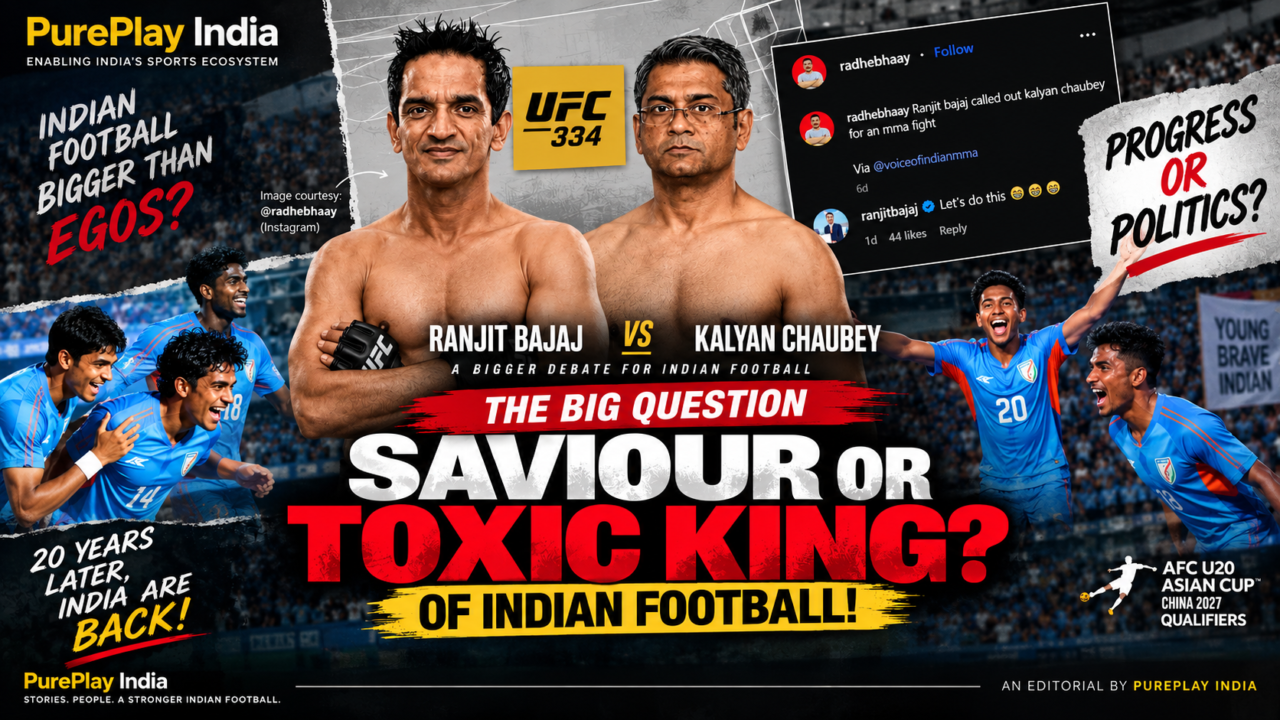
More than 24 hours after India’s U20 qualification, PurePlay India still could not find a congratulatory post from Ranjit Bajaj celebrating the boys’ achievement. The public post visible today instead focuses on his continuing fight with Kalyan Chaubey and AIFF, using a UFC-style graphic around their dispute.
That is his choice. He is entitled to fight his battles with AIFF. But it raises a fair question: can the fight with the federation be separated from the boys wearing the India shirt? These players did not appoint Kalyan Chaubey. They did not create AIFF’s problems. They simply qualified India for Asia after 20 years.

Ranjit Bajaj’s public post visible today, focused on his dispute with Kalyan Chaubey and AIFF rather than India’s U20 qualification. Screenshot supplied to PurePlay India.
And that is where the uncomfortable question becomes unavoidable: is the absence of a congratulatory message because none of the players in this U20 squad came through Minerva? We cannot know his reason, and we will not pretend to. But the contrast is difficult to miss.
If these had been Minerva boys, would the tone have been different? Indian football fans have seen plenty of strong promotion around Minerva’s achievements, including the language of “Thok Denge” and the academy’s wins. There is nothing wrong with celebrating your academy. The problem begins when academy pride starts looking like an alternative to national-team pride.
And this is not an argument against Minerva. In fact, the academy’s success makes the point stronger: Indian football needs successful academies, but successful academies should feed the national team — not compete with it for identity.
Renedy Singh and the bigger Manipur football story
There is another name that deserves recognition when we talk about the development of Manipuri football: former India captain Renedy Singh. His contribution to the state’s football culture long predates the current social-media battles. He has worked across youth, reserve and senior football, and his coaching career has included Bengaluru FC and an ISL head-coaching stint.
Renedy does not need to claim ownership of every player who comes through Manipur. His work speaks for itself. If the conversation is about who should be considered for a future India senior-team coaching role, Renedy Singh deserves to be part of that conversation — not because he says he deserves it, but because his playing experience, coaching education and work across different levels of Indian football make the case worth discussing.
That is the difference between building football and building a personal narrative.
Minerva has contributed. Classic Football Academy has contributed. Clubs, school programmes, local coaches and families across Manipur have contributed. So have countless coaches who worked with these players before bigger academies and clubs came calling.
There has never needed to be a “Manipur versus India” narrative — because Manipur’s success is part of India’s success. The same should be true of Minerva, Bengaluru, Punjab FC, Classic Football Academy or any other academy and club developing Indian players.
The line Indian football should never cross
If you genuinely feel disappointed when India wins, you are not defending Indian football. You are defending a rivalry, an ego or a narrative.
These boys did not play for AIFF. They played for India.
This is the part that seems to get lost.
The boys in Tashkent were not playing for the AIFF president. They were not playing for Kalyan Chaubey. They were not playing for Minerva Academy. They were not playing for Punjab FC. They were not playing for Bengaluru FC. They were not playing for any administrator’s personal reputation.
They were playing for India.
And they delivered.
The official squad contained players from clubs including Punjab FC, Bengaluru FC and Shabab Al Ahli, among others. Most importantly for this particular debate, there was not a single Minerva Academy player listed in India’s official 23-man U20 squad for these qualifiers.
That is an important fact.
Because Indian football is bigger than any one academy. Bigger than any one club. Bigger than any one administrator. And certainly bigger than any one individual.
And look where many of these boys come from
There is another uncomfortable reality that toxic fandom conveniently ignores whenever it suits an argument.
Indian football continues to benefit enormously from talent coming out of Manipur. Of the 23 players named for these qualifiers, sixteen trace back to the state — more than two-thirds of the entire squad.
The Manipur contingent · India U20, AFC qualifiers, Tashkent 2026


That is the beauty of Indian football. Talent does not belong to one academy. It does not belong to one state. It does not belong to one administrator. It travels — from Imphal to Bengaluru, from Chandigarh to Kolkata, from Goa to Punjab, from small football grounds to professional stadiums.
That is how a football ecosystem is supposed to work. It is also exactly why reducing every conversation to “my academy versus yours” is such a betrayal of what actually built this squad — and why a state that keeps producing this much talent deserves to be named properly, not folded into a vague regional label.
Mahesh Gawali didn’t need theatrics
And then there is Mahesh Gawali.
The U20 head coach didn’t need to create a social-media war. He didn’t need to declare himself the saviour of Indian football. He didn’t need to manufacture outrage.
He needed to prepare a group of young footballers for three extremely difficult matches.
And when it mattered, his team delivered.
India opened the campaign with a 1–0 win over Syria. They then suffered a heavy 0–4 defeat against Uzbekistan. Then came Bangladesh.
And India responded. Not with social-media rhetoric. Not with excuses. Not with drama. With football.
The first goal came through Danny Meitei Laishram in the 25th minute. The second came through Vishal Yadav in the 60th, an acrobatic finish off a Rishikanta flick-on from a long throw. And Md Arbash completed the scoring in the 79th minute, finishing a move initiated by Yaipharemba Chingakham that unlocked Bangladesh’s defence.
Three goals. Three different types of finishes. And, more importantly, a disciplined performance that saw India control the game and protect their advantage.
Football is emotional. But emotion alone does not win football matches.
Tactics do.
Discipline does.
Preparation does.
Execution does.
Mahesh Gawali’s boys showed all four. None of it needed a hashtag war to be validated.


Three of India’s four goals this campaign were scored by Manipuri players. The fourth goal, Vishal Yadav’s, was created by a Rishikanta Meitei Laishram flick-on — also Manipur.
The Minerva vs India narrative is even more disturbing
This is where Indian football fans also need to look at themselves. Why should anyone be choosing between India and an Indian academy? Why should an India youth team be treated as an opponent to be emotionally defeated rather than a team to be supported?
The recent U15 controversy makes the point. Bajaj was appointed as manager of the India U15 team while Bibiano Fernandes was named head coach, before Bajaj rejected the arrangement over differences in footballing philosophy. Public reporting confirms that the dispute quickly became about structure, roles and competing football philosophies.
Fine. Debate the structure. Debate AIFF. Debate who should lead the team. But once the boys walk onto the pitch wearing India, the argument should end at the touchline.
Minerva U15 versus India U15 should never become “Minerva versus India”. An academy can be proud of its identity while still wanting the national team to succeed.
You can admire Minerva, criticise AIFF, support Ranjit Bajaj, dislike Kalyan Chaubey and demand radical reform — and still support India every single time the team plays. These things are not mutually exclusive.
Winning should not threaten anyone’s narrative
This is the central point.
If your argument is that Indian football is badly managed, then an Indian team qualifying for the AFC U20 Asian Cup does not destroy your argument. It gives you something to celebrate.
If your argument is that AIFF needs reform, then celebrate the players and continue demanding reform.
If your argument is that Indian football needs better youth development, then celebrate the youngsters who have broken through.
If your argument is that the system is broken, then demand that the system learn from what these boys have done right.
But don’t wait for Indian football to fail so that you can say “I told you so,” and then disappear when India succeeds.
That is not supporting Indian football.
That is supporting a narrative. And a fandom that only shows up for the losses is not a fandom at all.
We should be angry. But we should also be proud.
As Indian football fans, we have every right to be frustrated. It hurts when India loses to teams we believe we should beat. It hurts to watch the senior national team struggle. It hurts to see the ISL fighting for stability after more than a decade. It hurts to see the enormous potential of Indian football repeatedly held back by poor decisions.
But none of that gives us the right to abandon the players, troll them, or treat their achievements as inconvenient.
Because these boys did not create Indian football’s problems.
They inherited them.
And yet they still walked onto a football pitch wearing the Tricolour. They still fought. They still ran. They still took the hits.
And after losing 0–4 to Uzbekistan, they still came back and beat Bangladesh 3–0.
That is exactly the mentality we should be demanding from Indian football — and exactly the mentality toxic fandom fails to match.
PurePlay Perspective
Congratulations, India. You have earned your place. Now earn the fandom that deserves you back.
Congratulations to Mahesh Gawali. Congratulations to his coaching staff. Congratulations to every player who fought for this qualification. Congratulations to their clubs and academies. Congratulations to the families who supported these boys. And congratulations to the coaches across India who have worked with them long before they ever wore the national jersey.
Most importantly, congratulations to the players.
You have done something Indian U20 teams have failed to do for two decades. You have put India back on the AFC U20 Asian Cup stage. You have earned your place.
And Indian football fans should celebrate you. Not because AIFF has suddenly become perfect. Not because every problem in Indian football has disappeared. Not because one individual deserves all the credit.
But because India won.
And when India wins, every genuine Indian football fan should be happy. Even the people who spent yesterday explaining why Indian football is broken.
Especially them.
Because the national team is not anybody’s personal property.
India belongs to all of us.
And when the boys wearing that blue jersey win, there should be no “my academy”, no “my project”, no “my philosophy”, no “my way”.
There should only be three words:
INDIA. INDIA. INDIA.