
By PurePlay India Staff · July 15, 2026 · 7 min read
Aggregated and adapted from verified match reporting, official disciplinary records, and the IFAB Laws of the Game — sources credited throughout and in the reporting notes below.
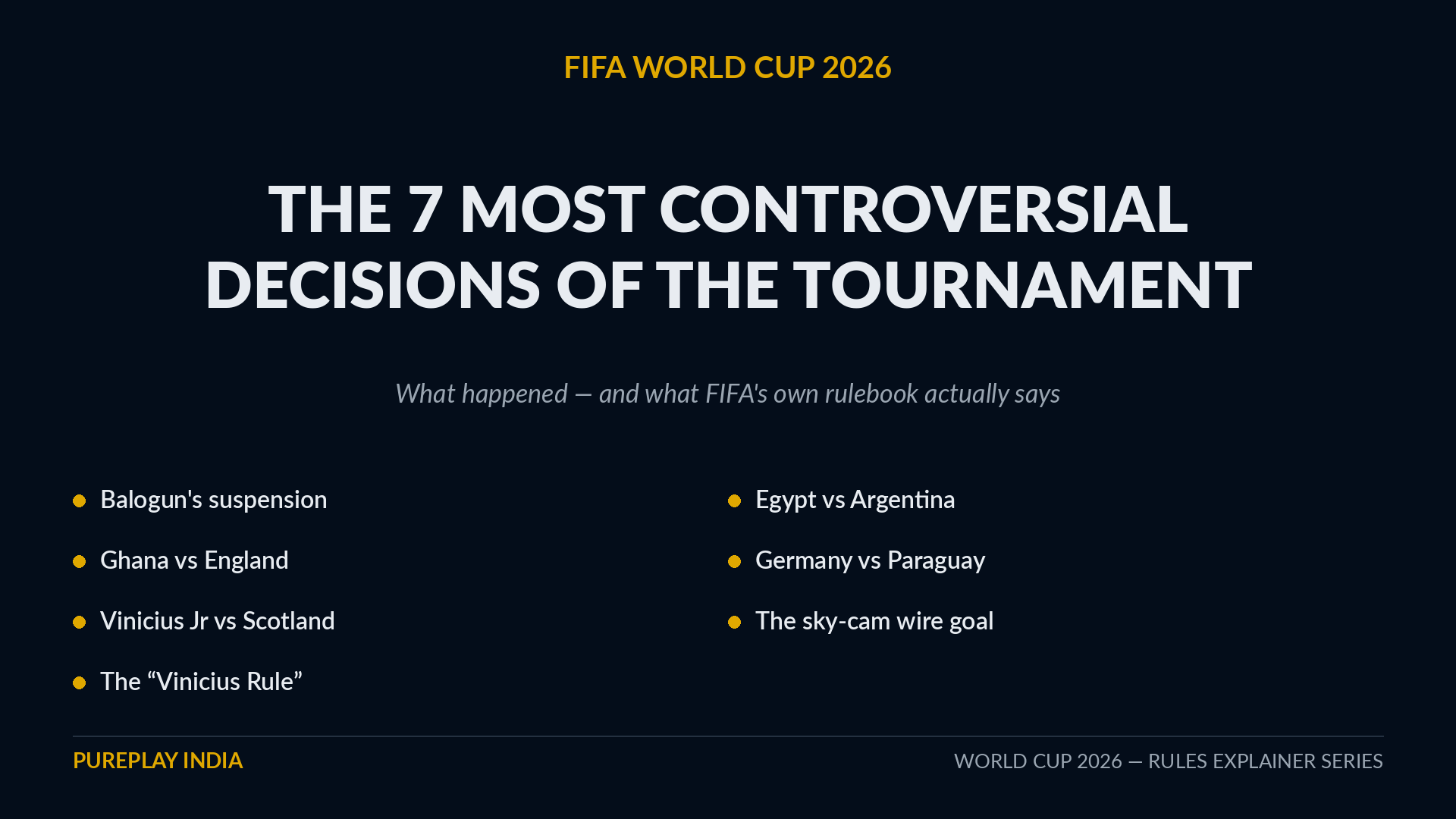
Seven decisions. Seven flashpoints. From a red card undone by a phone call to the White House, to a goal that may have bounced off a camera wire, the 2026 World Cup has turned the Laws of the Game into as big a talking point as the football itself. Here’s exactly what happened in each case — and what FIFA’s own rulebook says about it.
Graphic: PurePlay India
1. Folarin Balogun’s Vanishing Suspension

Photo: Bryan Berlin / WikiPortraits (CC BY-SA 4.0)
On July 1, USA forward Folarin Balogun was shown a straight red card in the Round of 32 win over Bosnia and Herzegovina — a studs-up, ankle-height challenge on defender Tarik Muharemović that the referee, after a VAR review, ruled serious foul play. Under FIFA’s own tournament regulations, that should have been the end of it: a straight red carries an automatic one-match ban, and Balogun was due to sit out the Round of 16 tie against Belgium.
It wasn’t. Two days before that match, U.S. President Donald Trump called FIFA president Gianni Infantino directly, telling reporters afterward: “I asked for a review because I didn’t think it was a foul.” FIFA’s Disciplinary Committee obliged — not by overturning the red card itself, but by suspending the ban’s implementation for a one-year probationary period, clearing Balogun to play immediately. He became the first player since 1962 to avoid sitting out a game after a World Cup sending-off. Belgium’s federation appealed; the appeal failed. The White House posted “USA-USA-USA 🦅” on X; Belgium’s team account fired back “Overturn this. 🧏♂️ #USABEL” — a pointed nod to the mouth-covering rule further down this list. The USA lost the match 4-1 anyway, and Balogun later said the episode had “negatively affected” the squad.
WHAT FIFA’S RULES SAY
Article 10.5 of the FIFA World Cup 2026 Competition Regulations makes a one-match ban automatic after any red card. But Article 27 of the FIFA Disciplinary Code gives the judicial body a separate power: it “may decide to fully or partially suspend the implementation of a disciplinary measure.” That clause exists mainly for probationary leniency in ordinary disciplinary cases — not, historically, to let a suspended player walk straight back onto the pitch at a World Cup. Applying it here is what made the decision so contentious: nothing in the letter of the rules was broken, but a discretionary clause was used in a way it had essentially never been used before.
2. Egypt vs Argentina — A Disallowed Goal, a Shirt-Pull, and an Official Complaint
Graphic: PurePlay India
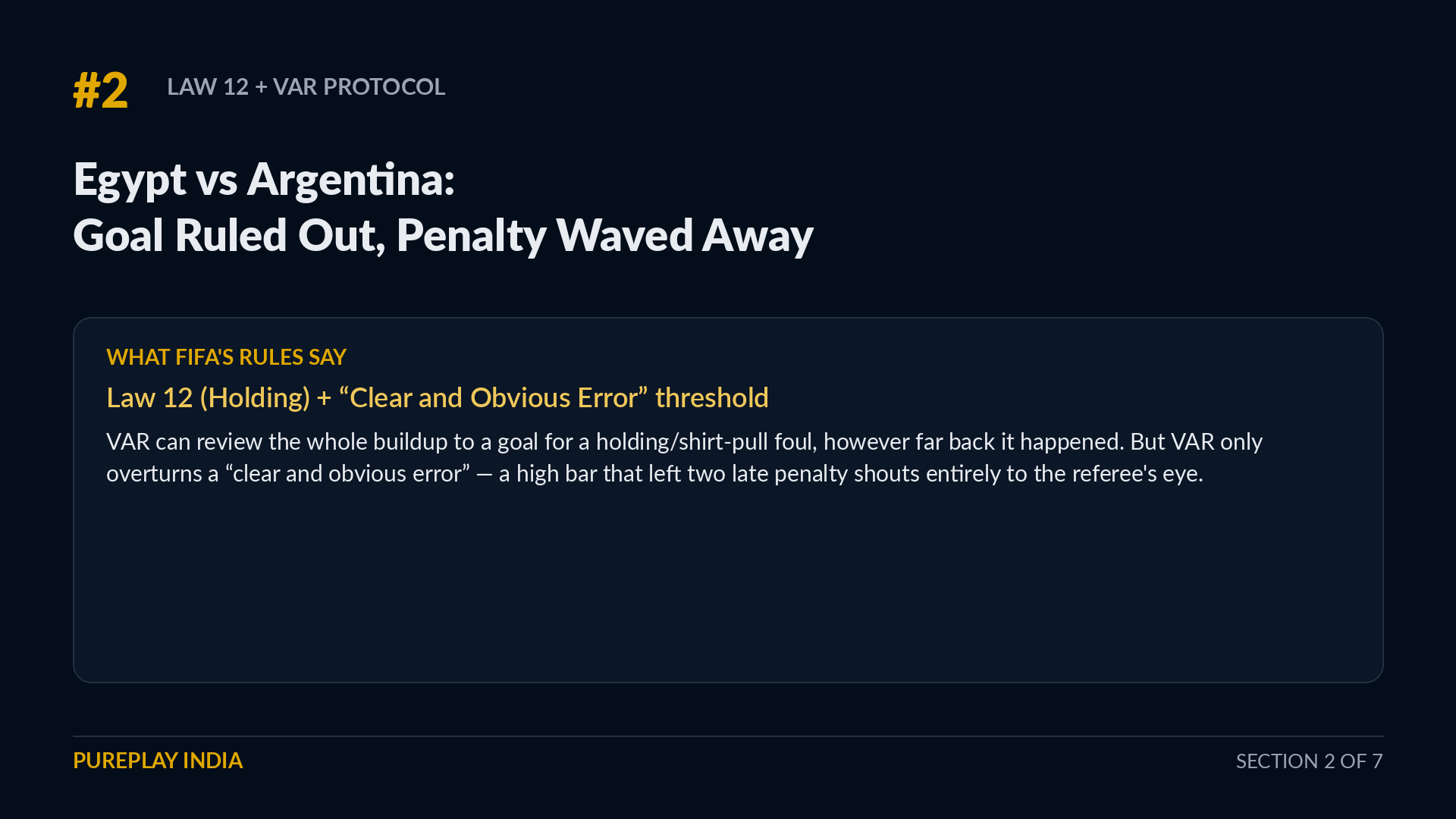
Argentina trailed Egypt 2-0 in their Round of 16 tie before storming back to win 3-2 — but it’s the officiating, not the comeback, that Egypt’s football association wanted FIFA to answer for. Egypt’s Mostafa Ziko thought he’d scored, only for VAR to rule out the goal: replays showed defender Marwan Attia standing on Lisandro Martínez’s foot and appearing to hold his shirt just outside the box, moments before Egypt’s counter-attack. Late in the match, a penalty shout for Hamdy Fathy was waved away, and in the 92nd minute — seconds before Argentina’s winning goal — Mohamed Salah appealed that he’d been fouled by Julián Álvarez. VAR didn’t intervene either time. Egyptian FA president Hany Abo Rida filed an official complaint against referee François Letexier and his assistants.
WHAT FIFA’S RULES SAY
Law 12 makes holding an opponent — shirt-pulling included — a direct free-kick offence anywhere on the pitch, and a penalty if it happens inside the box. Under the VAR protocol, the review team can examine the entire “attacking phase” that leads to a goal, not just the shot itself — which is exactly why Egypt’s goal was chalked off for something that happened well outside the penalty area. But VAR is only permitted to intervene for a “clear and obvious error” or a serious missed incident. That’s a genuinely high, subjective bar — and it’s the reason the Salah and Fathy shouts, both far more marginal calls in real time, were left entirely to the on-field referee’s judgment.
3. Ghana vs England — “VAR Went for a Coffee”

Photo: Bryan Berlin / WikiPortraits (CC BY-SA 4.0)
With the score goalless in the 79th minute, Ghana forward Adu went down in England’s box under a challenge from defender Ezri Konsa, who made no contact with the ball and caught Adu on the knee. No penalty was given, and VAR did not send the referee to the monitor. Ghana head coach Carlo Queiroz didn’t hold back afterward: “VAR went for a coffee.”
WHAT FIFA’S RULES SAY
Law 12 says a direct free-kick — a penalty, inside the box — is awarded when a foul is committed “carelessly, recklessly, or using excessive force.” Whether a specific piece of contact clears that bar is a judgment call, not a fact to be measured. And because VAR’s mandate is to fix clear and obvious errors rather than re-referee marginal ones, an on-field “no penalty” decision on a close call like this one is, by design, very hard to overturn — which is exactly the pattern fans and coaches keep running into this tournament.
4. Germany vs Paraguay — A Goalkeeper, a Push, and a Disallowed Winner

Photo: Bryan Berlin / WikiPortraits (CC BY-SA 4.0)
Jonathan Tah thought he’d scored for Germany, only for referee Jalal Jayed to chalk the goal off after a VAR review found defender Waldemar Anton had fouled Paraguay goalkeeper Orlando Gill in the buildup. Germany head coach Julian Nagelsmann called the decision “a joke” afterward.
WHAT FIFA’S RULES SAY
Same principle as the Egypt game: VAR can review the whole attacking phase for a foul, and an offence against a goalkeeper contesting the ball in the buildup is grounds to disallow a goal under Law 12. The dispute here isn’t about whether that power exists — it’s about whether the contact was actually significant enough to be a foul at all, which, again, comes down to the reviewing official’s read of “careless, reckless, or excessive.”
5. Vinícius Júnior’s Disallowed Goal vs Scotland
Graphic: PurePlay India
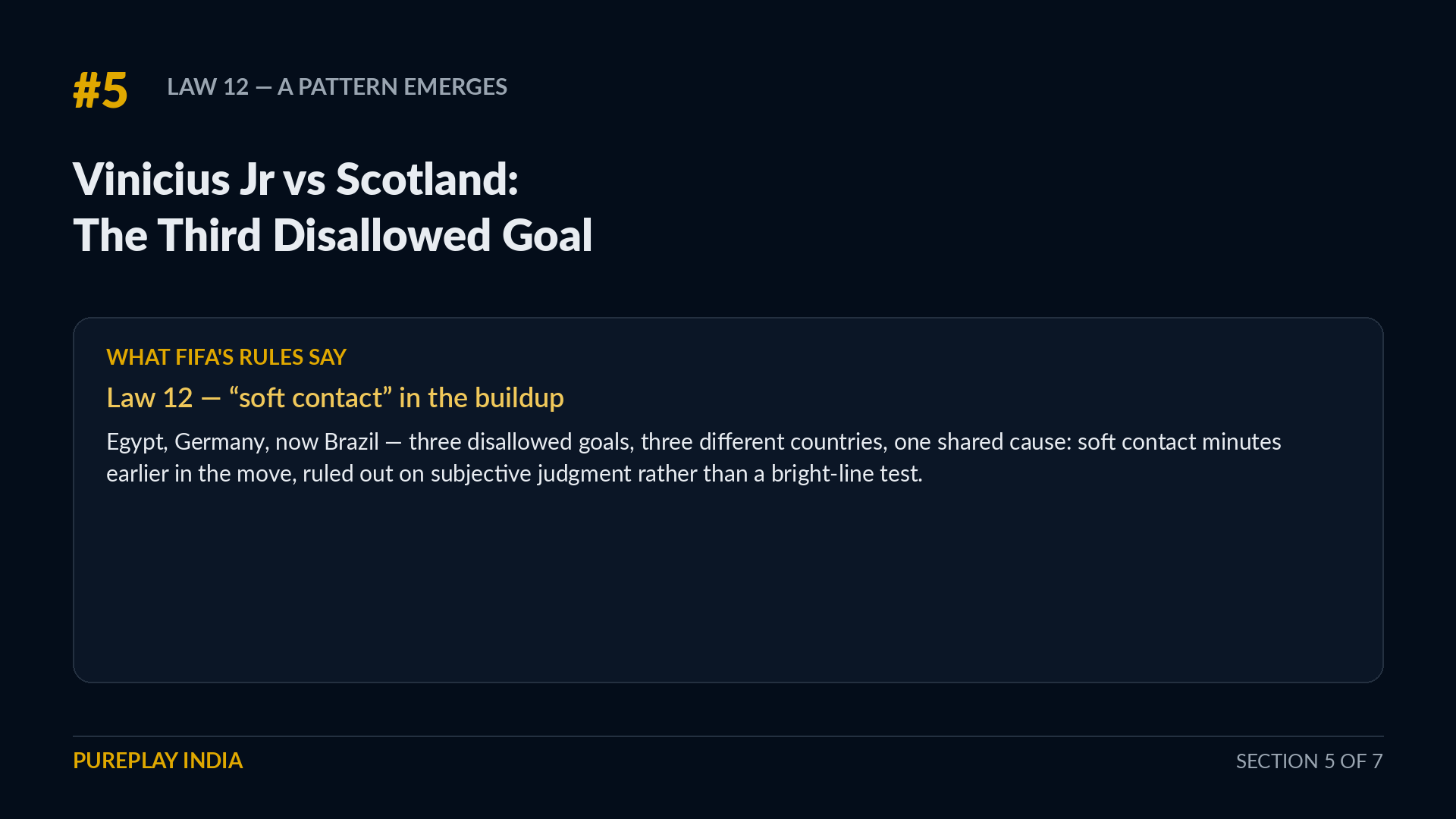
In the 22nd minute, Vinícius Júnior put the ball in the net and thought he’d doubled Brazil’s lead. VAR recommended an on-field review, and the referee ruled the goal out for a foul on Scotland’s Hendry in the buildup — contact that looked, to most watching, distinctly soft.
WHAT FIFA’S RULES SAY
It’s the same Law 12 buildup-foul review that disallowed Egypt’s and Germany’s goals — and by this point in the tournament, that’s the pattern worth noticing. Three separate disallowed goals, three separate countries, one shared root cause: a rule that lets referees rule out a goal for “soft” contact minutes earlier in the move, decided entirely by subjective judgment rather than a bright-line test.
6. England vs Norway — The Sky-Cam Wire Goal
Graphic: PurePlay India
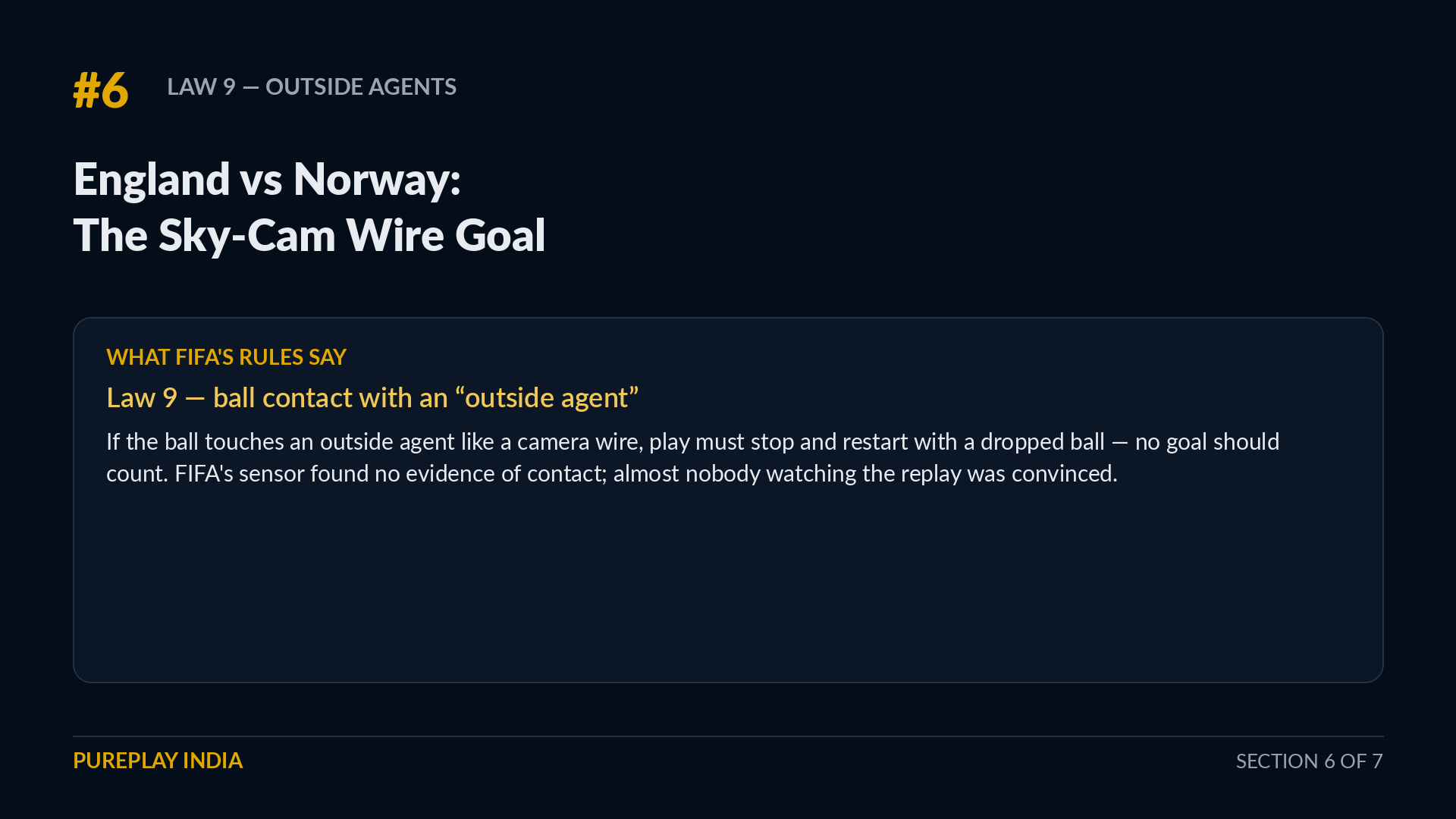
England beat Norway 2-1 in extra time in the quarterfinal on July 11 — but the flashpoint came earlier, in first-half stoppage time, when the ball appeared to clip the overhead sky-cam wire before dropping sharply to England’s Elliot Anderson, setting up the equaliser. Norway goalkeeper Ørjan Nyland tried to flag it to the officials in real time; manager Ståle Solbakken did the same from the touchline. FIFA later said its “Connected Ball” sensor data showed no impact spike in the air and therefore no evidence the ball touched the wire — the goal stood. Solbakken wasn’t convinced, saying afterward the ball had dropped “straight from heaven” and that the wire “deserves an assist.” Fans pointed out that FIFA had previously used the same ball-sensor technology to detect the faintest touch on a Croatian player in an earlier match, fuelling further suspicion about the inconsistency.
WHAT FIFA’S RULES SAY
Law 9 treats a camera wire as an “outside agent” — something that isn’t part of the match. If the ball touches one, play must stop immediately and restart with a dropped ball at the point of contact; nothing that happens afterward, goal included, should count. Unlike every other entry on this list, this isn’t a matter of subjective judgment — it’s a single yes-or-no question of fact. That’s exactly why FIFA leaned on sensor data instead of a referee’s read of the incident, and why the explanation satisfied almost no one watching the replay.
7. The “Vinícius Rule” Makes Its World Cup Debut

Photo: Bryan Berlin / WikiPortraits (CC BY-SA 4.0)
Months before the tournament, Vinícius Júnior said he’d been racially abused by Benfica’s Gianluca Prestianni during a Champions League match in February — with Prestianni allegedly covering his mouth while speaking to hide what he was saying from cameras and officials. In response, IFAB’s lawmakers met in Vancouver and unanimously strengthened the Laws of the Game: a player who deliberately covers their mouth while confronting an opponent can now be shown a straight red card. At this World Cup, Paraguay’s Miguel Almirón became the first player in the tournament’s history sent off under the new rule, dismissed in Paraguay’s second group-stage match, against Turkey — days after he’d already been booked for simulation in the tournament opener against the USA.
WHAT FIFA’S RULES SAY
This one isn’t a disputed interpretation — it’s a brand-new amendment to Law 12’s misconduct provisions, added specifically because proving discriminatory language after the fact is nearly impossible once it’s been hidden from view. Referees now have explicit authority to treat the concealment itself, not just the words underneath it, as a sending-off offence.
The Common Thread
Six of these seven controversies trace back to the same source: Law 12 hands referees and VAR officials a genuinely subjective scale — careless, reckless, excessive force; clear and obvious error or not — and every one of this tournament’s disallowed goals and denied penalties lives somewhere on that scale, where reasonable officials can watch the same replay and land in different places. The sky-cam wire is the outlier precisely because it wasn’t subjective at all — it was a factual question FIFA chose to answer with sensor data instead of the naked eye, and still couldn’t convince anyone.
The Balogun case is the strangest of the seven for the opposite reason. Nothing about it was ambiguous. The red card was clear, the one-match ban was automatic, and the only real question was whether a discretionary clause built for something else entirely should have been used to undo it after a phone call from the sitting president of the host nation. The rulebook allowed it. Whether it should have is a different question — and it’s one FIFA will likely be asked again long after this tournament ends.